
Nighttime Research Spotlight #2 — Climate After Dark
Why the night must become a climate variable

Climate policy still treats cities as if they only function during the day. Yet heat, energy use, labour patterns, and ecological behaviour all shift dramatically after dark. A growing body of research argues that this blind spot is now one of the biggest weaknesses in global climate adaptation — and that the night must be treated as its own environmental and social domain.
This edition of Nighttime Research Spotlight looks at a recent comment article in Nature Climate Change by Alessio Kolioulis, Andreina Seijas, and Michele Acuto, which makes a compelling case for integrating night studies into climate science.
Why the night matters for climate adaptation
The authors argue that climate science has largely overlooked what happens between sunset and sunrise — despite the fact that cities experience some of their most acute climate stresses at night.
They introduce the “nighttime–climate nexus”, a framework that recognises the night as both:
a driver of climate vulnerability, and
a site of adaptation, as cities increasingly shift work, mobility, and social life into cooler hours.
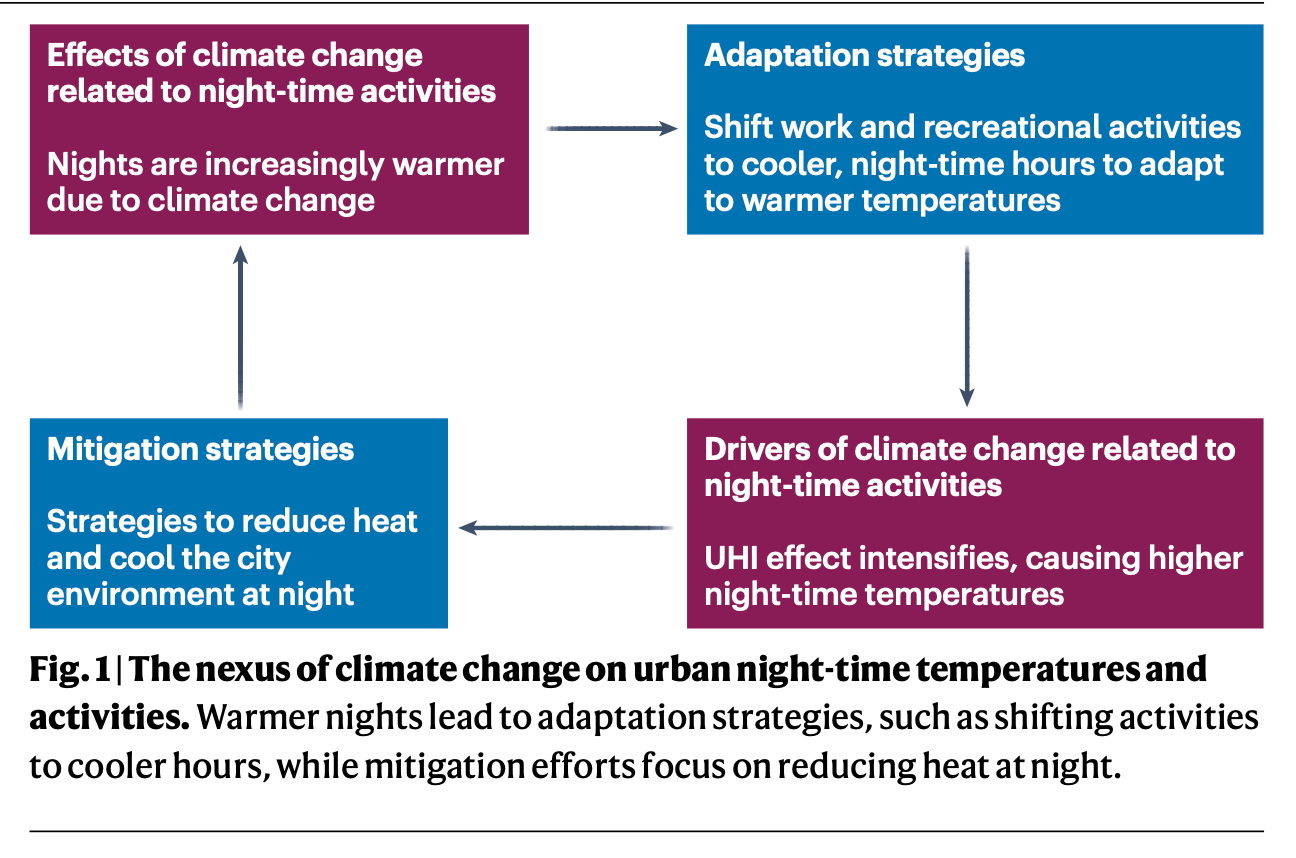
“Night-time activities substantially impact climate change yet remain widely overlooked in climate research and action.” Nature Climate Change volume 14 (2024), p. 1008
While many cities now have nighttime economy, mobility, or safety strategies, these initiatives are rarely informed by climate science. As a result, climate adaptation and nighttime planning continue to operate on parallel tracks.
Night as a driver of climate risk
Heat behaves differently at night. Dense neighbourhoods store warmth during the day, creating nocturnal heat islands that keep temperatures dangerously high well after sunset. Cooling systems often work hardest overnight, increasing energy demand and household costs.
The burden falls unevenly. Night-shift workers, older adults, people experiencing housing precarity, and low-income communities face the harshest combination of heat exposure and limited access to cooling or safe public space. These vulnerabilities are rarely captured in resilience planning.
Beyond humans, artificial lighting and nighttime noise disrupt ecosystems, altering the behaviour of birds, insects, and mammals in ways that are largely absent from climate datasets.
Night as a site of adaptation
Cities are already adapting — often unintentionally — by shifting activity into cooler evening and night-time hours. Logistics, manufacturing, retail, service work, and hospitality increasingly operate after dark.
Some countries, including Spain, the United Arab Emirates, and Saudi Arabia, have adjusted work schedules to avoid peak daytime heat. Yet these shifts are rarely integrated into climate planning. Nighttime economy strategies in cities such as London, New York, and Melbourne seldom address heat risk, nocturnal mobility, or energy demand.
Without planning for what actually happens after dark, adaptation strategies miss both real risks and real opportunities.
What the article proposes
The authors push for several practical changes that cities and researchers can act on
Build nocturnal data into climate tools
Measure temperature, labour patterns, biodiversity, and infrastructure performance across day and night.Link nighttime strategies to climate adaptation
From cooling centres to night buses, services should reflect how cities are used after dark.Integrate nocturnal realities into heat-action plans
Early-morning and late-evening services matter as much as daytime provision.Treat lighting and shading as climate infrastructure
Not just design features, but tools for reducing heat and energy demand.Bring global city networks into the conversation
Organisations such as C40 and ICLEI should incorporate temporal rhythms into climate strategies.
The article’s most important contribution is conceptual: it insists that night is not just a time on the clock, but a space of social life, economic activity, vulnerability, and ecological change. When the night is treated as invisible, cities remain blind to major climate risks — and to meaningful paths for adaptation.
Integrating Night Studies into Climate Science is available online:
https://24hournation.com/wp-content/uploads/Integrating-night-studies-into-climate-science-1.pdf
Author: Rahul Murdeshwar (VibeLab)
Editors: Anna Marazuela Kim and Kerronia Thomas (Nighttime Foundation)
The power of Nighttime Research
Nighttime research is essential to understanding how culture, community, and urban life actually function after dark — and to ensure the people who make nightlife possible can shape what comes next.
The Nighttime Foundation bridges nightlife enthusiasts, creators, industry networks, and governments worldwide. By building on these connections, we aim to strengthen and amplify the ecosystems that keep nightlife thriving — not only as a subject of study, but as a living public good.
Missed the previous Spotlight? Read #1 here.